Scientists Create Largest-Ever 3D Map of Early Universe Signal, Revealing Hidden Galaxies
Looking deep into space is looking back in time, and astronomers have just pushed that view further and more clearly than ever before. A team of researchers has constructed the largest and most detailed three-dimensional map yet of a specific light signal from the early universe — one that has revealed galaxies and vast clouds of gas that existed between 9 and 11 billion years ago, structures that were previously invisible to us. It is the kind of result that expands what cosmologists thought was knowable about the universe's formative period.
The Signal at the Heart of the Discovery
The specific signal being mapped is the Lyman-alpha emission line — ultraviolet light emitted by hydrogen atoms in the early universe that has been redshifted into the visible spectrum by the time it reaches us. Hydrogen is the most abundant element in the cosmos, and it was everywhere in the early universe, filling the spaces between the first galaxies and forming the diffuse intergalactic medium that connected them. Detecting and mapping Lyman-alpha emission at this scale is technically extraordinary because the signal is faint, diffuse, and tangled up with noise from instruments and intervening matter.
What makes this particular map unprecedented is its three-dimensional nature and its spatial extent. Previous surveys captured slices or limited volumes of this signal. The new map covers a vastly larger region and reconstructs the three-dimensional positions of the emitting structures — not just where the light appears on the sky, but how far away those structures were, giving cosmologists a genuine volumetric picture of how matter was distributed during one of the universe's most active periods of galaxy formation.
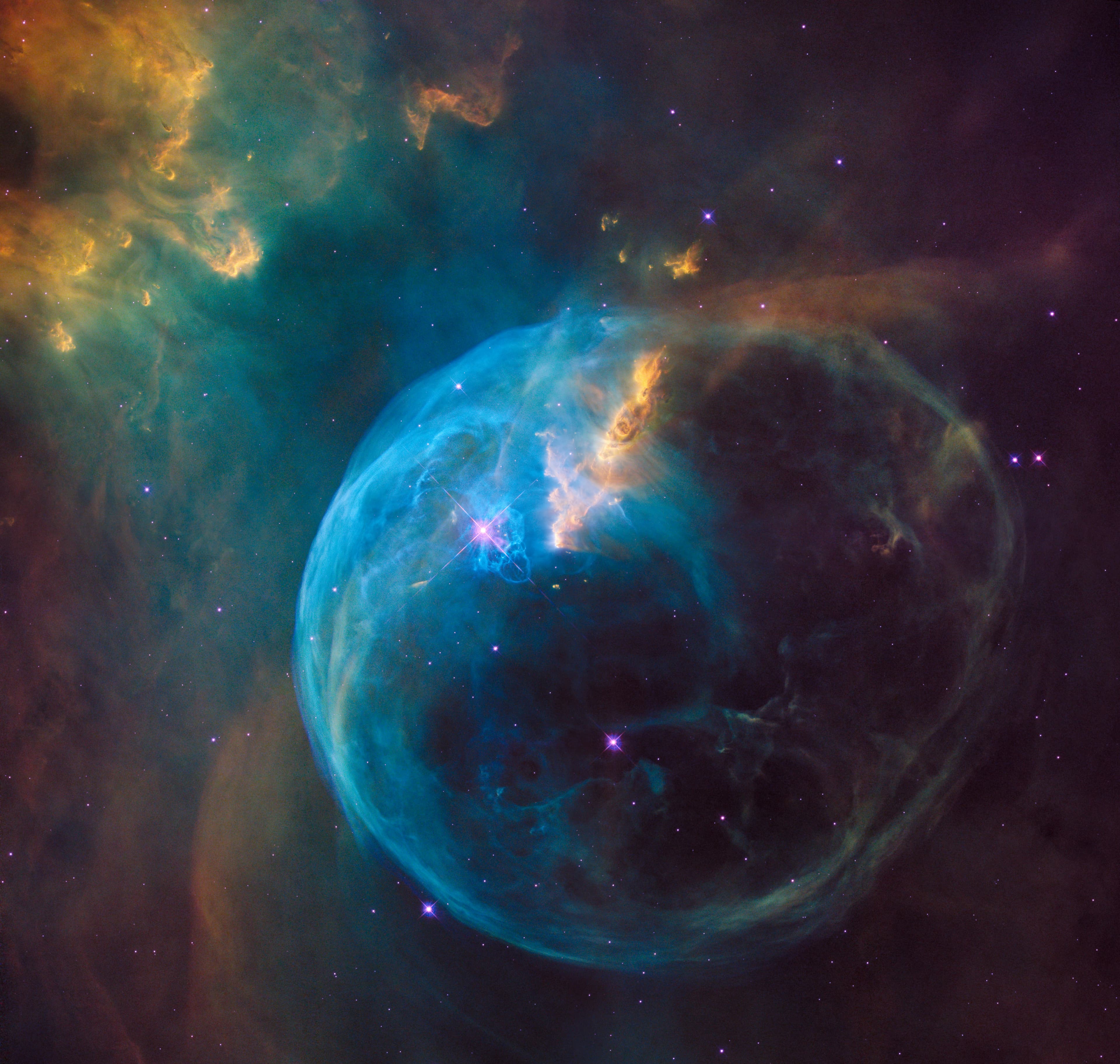
Hidden Galaxies and What They Tell Us
Some of the structures revealed by the new map were previously hidden not because they are faint by cosmic standards, but because conventional galaxy surveys are optimized to detect starlight — the concentrated, bright cores of galaxies — rather than the diffuse extended emission that surrounds them and fills the space between them. The Lyman-alpha signal traces hydrogen regardless of whether it is in a galaxy or in the intergalactic medium, which means the map reveals a more complete picture of where matter actually was, not just where the brightest concentrations happened to be.
The hidden galaxies uncovered in the map are particularly interesting to cosmologists studying the so-called cosmic web — the vast network of filaments, sheets, and voids that structure the universe on the largest scales. Galaxy formation is not random; it follows the scaffolding of dark matter, with galaxies tending to form at the nodes and along the filaments of that structure. Finding previously hidden galaxies in the new map adds data points to our understanding of how well the standard model of cosmic structure formation actually describes what the universe was doing 10 billion years ago.
The Technical Achievement Behind the Map
Producing a three-dimensional map of this kind requires not just collecting light but interpreting it with enough precision to assign reliable distances to structures billions of light-years away. The team used spectroscopic data — measurements of how the wavelength of light has shifted due to the expansion of the universe — to determine distances, and then stacked and processed enormous volumes of observational data to extract the faint Lyman-alpha signal from the background noise.
The computational demands of this kind of analysis have grown in step with the ambition of the surveys themselves. Modern cosmological mapping increasingly depends on machine learning tools to separate signal from noise in datasets that would overwhelm traditional analysis methods. The fact that this map was achievable now, rather than a decade ago, reflects advances in both observational hardware — bigger telescopes, more sensitive detectors — and the data processing pipelines that turn raw photon counts into scientific results.
What the Early Universe Looked Like 10 Billion Years Ago
The 9 to 11 billion year lookback time window that this map covers corresponds to a period astronomers sometimes call cosmic noon — the era when star formation across the universe was near its peak, galaxies were actively growing, and the large-scale structure we see today was being assembled. Understanding this period in detail is central to answering some of cosmology's most fundamental questions: why do galaxies have the masses and shapes they do, what role did dark matter play in organizing the universe's structure, and how did the intergalactic medium evolve from the hot, dense state of the early universe to the relatively tenuous medium we observe today.
The new 3D map does not answer all of those questions — no single dataset does — but it provides the kind of high-fidelity observational anchor that theoretical models can be tested against. When simulations of cosmic evolution match the structures seen in maps like this one, it builds confidence that the underlying physics is understood. When they don't, it points toward something missing in the model. Either outcome advances knowledge, which is ultimately what makes results like this one matter beyond the headline.
AI Summary
Generate a summary with AI


