James Webb Space Telescope captures the 'Exposed Cranium' nebula shaped by a dying star
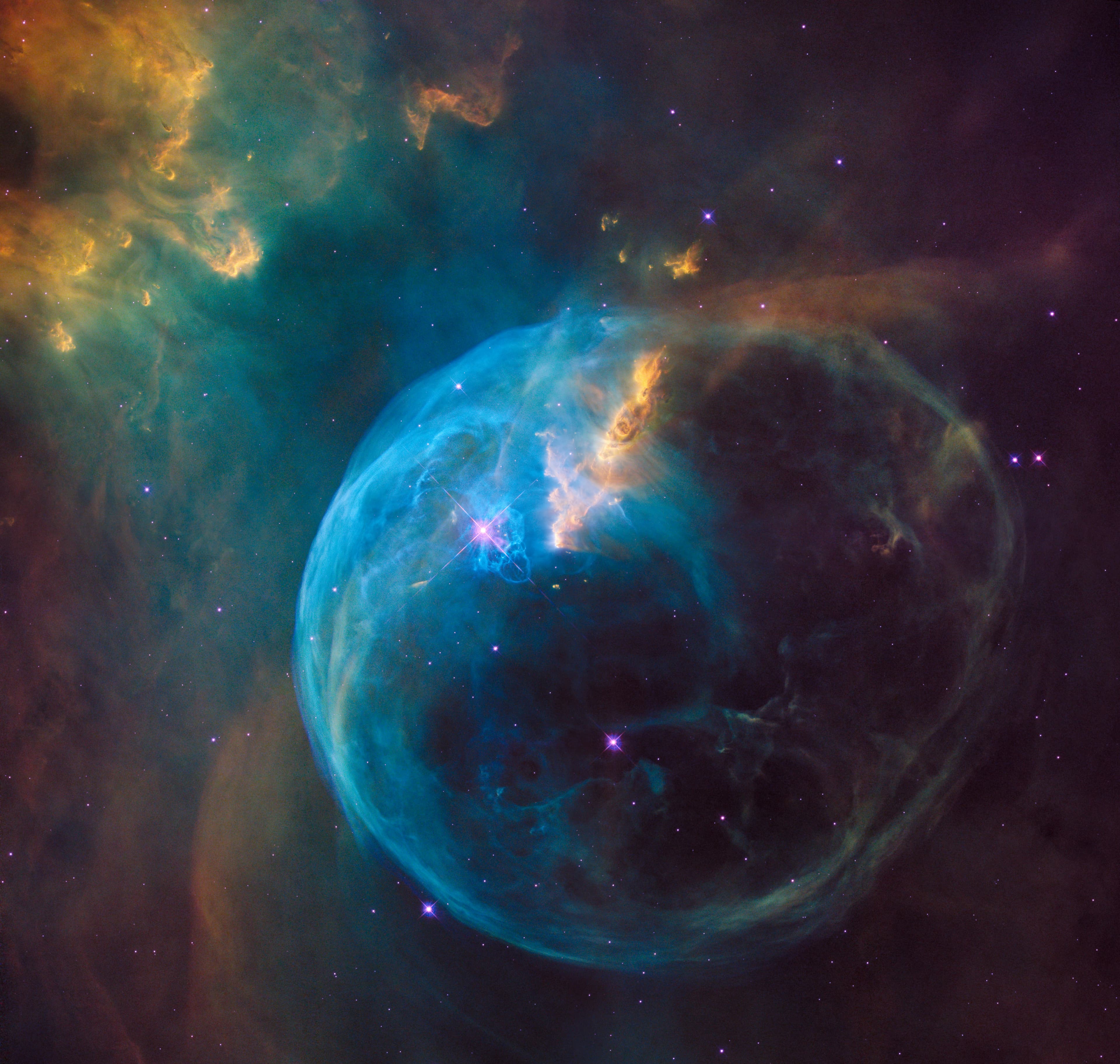
NASA's James Webb Space Telescope has imaged a new nebula that researchers have nicknamed the Exposed Cranium. The name comes from the structure's appearance: a roughly spherical shell of glowing gas with hollowed-out interior regions that, in the infrared imaging Webb produces, bears an uncomfortable resemblance to a skull. The structure was created by a massive dying star whose outflowing winds and intense radiation are physically pushing and reshaping the gas and dust cloud surrounding it.
This is not a cosmetic observation. The image gives astrophysicists a close look at a process that ultimately determines how much of a dying star's material gets recycled into the next generation of stars and planets. When a massive star, typically one with at least eight times the mass of the Sun, reaches the end of its hydrogen-burning life, it enters phases where it sheds enormous quantities of mass through stellar winds. Those winds carve out cavities in the surrounding nebula, compress gas into dense shells, and trigger conditions that can lead to new star formation in the very cloud the dying star is destroying.
What Webb's infrared imaging reveals that optical telescopes cannot
Webb observes primarily in near-infrared and mid-infrared wavelengths, which pass through dust clouds that block visible light entirely. Earlier telescopes like Hubble, which operates mainly in optical and ultraviolet wavelengths, could not see through the thick dust shells surrounding nebulae like the Exposed Cranium in sufficient detail to map their internal structure. Webb's NIRCam instrument, which covers wavelengths between 0.6 and 5 micrometers, and its MIRI instrument, covering 5 to 28 micrometers, together produce images that show both the hot gas near the central star and the cooler dust structures further out.
In the Exposed Cranium image, scientists can identify distinct structural layers. The innermost region, closest to the dying star, shows ionized gas heated to tens of thousands of degrees by ultraviolet radiation. Further out, where the stellar wind has swept up ambient material, there is a compressed shell of denser gas. Beyond that, the surrounding molecular cloud retains its colder, denser state. Mapping all three of those zones in a single image gives researchers a record of the star's mass-loss history over its final evolutionary stages.
The physics of what a dying massive star does to its environment
Massive stars in their final stages become Wolf-Rayet stars or luminous blue variables, both of which are characterized by extremely powerful stellar winds. A typical Wolf-Rayet star loses mass at a rate of roughly 10 to the negative 5 solar masses per year, meaning it ejects matter equivalent to about 1 percent of the Sun's total mass every thousand years. That might sound slow, but these stars are extremely massive to begin with, and the wind speeds involved reach 1,000 to 3,000 kilometers per second. At those velocities, the wind carries enough kinetic energy to physically excavate large cavities in the surrounding gas.
The boundary where the fast stellar wind collides with slower-moving previously ejected material is called the termination shock. At that boundary, kinetic energy converts to thermal energy, heating the gas to X-ray emitting temperatures. Webb's mid-infrared observations of the Exposed Cranium are particularly useful for studying what happens just outside that boundary, in the cooler shell of swept-up material that forms the nebula's outer wall. The thickness and density of that shell tells scientists how long the star has been in its current wind-driving phase.
What this observation adds to stellar evolution research
Understanding how massive stars shed mass before their final supernova explosion is one of the open problems in stellar astrophysics. The total mass a star retains at the moment of explosion determines what type of supernova it produces and what remnant it leaves behind, whether a neutron star or a black hole. Models of stellar evolution predict a range of possible mass-loss rates, but observational data to calibrate those models has been limited by the difficulty of imaging these systems in enough detail to distinguish the different physical zones.
The Exposed Cranium observation gives researchers a spatially resolved view of a nebula at a specific stage of this process. By measuring the chemical composition of different zones using Webb's spectroscopic capabilities, and by comparing the observed structure to theoretical models of wind-driven nebula expansion, the science team can constrain which evolutionary models best match what is actually happening. The research team's initial findings are expected to be submitted to the Astrophysical Journal, with peer review likely completed in the second half of 2026.
Webb's broader contribution to nebula science
Since becoming operational in July 2022, Webb has imaged dozens of nebulae with a level of spatial resolution and infrared sensitivity that no prior space telescope could match. Earlier milestones include the 2022 image of the Southern Ring Nebula, which revealed a second star in the system driving the nebula's unusual double-shell structure, and the Carina Nebula image that resolved individual protostars forming within dust pillars at the nebula's edge. Each of these observations produced data that directly revised or confirmed specific predictions from stellar evolution theory.
The Exposed Cranium fits that pattern. It is a target chosen because its geometry and stage of evolution make it a good test case for specific models of stellar wind interaction with the interstellar medium. Webb's 6.5-meter gold-coated beryllium mirror, operating at 40 Kelvin to reduce thermal noise in the infrared, allows it to detect signal from structures that would be invisible to any ground-based telescope or to Hubble. The full spectroscopic dataset from the Exposed Cranium observation is publicly available through the Mikulski Archive for Space Telescopes, accessible to any research group that wants to work with it.
AI Summary
Generate a summary with AI

